
Narrative Therapy
In the 70s and 80s, when New Zealanders Michael White and David Epston were developing Narrative Therapy as a social justice approach to therapeutic conversations challenging potentially unhealthy dominant personal narratives by rewriting them, both literally and conceptually, I was beginning my development into the writer-about-himself who wrote his novels as they happened. As such, by 1992 or so I had already lived out a portion of my material but had yet to publish anything. I started reading my stuff at open readings and made friends with a lot of people who wrote about their lives but it wasn’t as intimate—these others didn’t seem to be daring themselves to change, or daring the universe to be great with their writing, or whatever it was I wanted to do with mine. Around here somewhere, a friend used the phrase “narrative therapy” when I was describing my strange relationship to writing. For years I thought it was this person’s way of nut-shelling whatever he thought I was trying to do, and thinking, on some level, “Someday maybe I can start my own experimental psychological platform using this.”
Selves and Alter-selves
Artists and writers are understandably alarmed by the advent of artificial intelligence, how it’s eating up all the jobs, even creative pursuits long immune to economic developments. Warns Jane Friedman, “Like it or not, publishers are licensing books for A.I. training—and using A.I. themselves.” Creatives of every type are suspecting that a past era of art has come to a close, that art of every kind will be subsumed and replicated by digital tech. I’m adding my experiential knowledge to preserve the magic of creativity in light of its ongoing technological codification. I’ve spent my whole life playing the game of selective omniscience, learning how to be a writer about my life and life itself, in time becoming a citizen journalist, reviewer, interviewer, and published author of several volumes of fictionalized autobiography. All my years of dedication have made me an expert on what’s essential about expansion of self through writing and I’d like to share the particulars of this method of self-expansion.
You’re the Director
Each of us is the primary character in the life we’re living. Incredible as it is, Westerners en masse have been thoroughly distanced from this a priori existential evidence in the last several decades because of social and political and cultural agendas. In theory the world wide web is a near-total bank of human information but each of us is sole administrator and legislator of his/her own conception of the universe and what’s possible there, boiled down to our choice of posts on a newsfeed. You can see it on Facebook, people’s lifestyle choices and political preferences defining their prospects. Everyone acting from a position of self-arranged omnipotence of perception. But it happens offline too. This apparent omniscience is selective since we all feel limited by our circumstances, including especially our self-conceptions. I decide what’s possible to me and I act on these intuitive “certainties,” acting with less than sovereignty due to factors like economic status, politics, religion, and so on. If you look at your own life in light of the influence of this kind of received knowledge, you can probably say the same thing, or similar. When Jack Kerouac popularized writing about one’s life in a literary manner instead of making up imaginary stories, he was hailed as a visionary genius. Ken Kesey’s Merry Pranksters’ exhortation in the early sixties to “Stay in Your Own Movie” seemed refreshingly heretical—the idea that people could steer and direct their own lives was so far out of touch with mainstream top-down conditioning it carried the taste of wild wisdom. The technique I’m describing goes past autobiography into self-discovery and psycho-emotional adjustment unto reconfiguration. It can empower you by making you the author of your own life, the main character of your own creative adventure in development and experience, one with your own characteristic traits, ideals, and missions affecting your perceptions and choices. It can deepen your experience of life and give direction and depth to your participation in life’s experiences. Selective omniscience, directed, can give at least one new dimension to your life—to recognize yourself as its protagonist not its bystander. It gives you the sense of a plot to fulfill. Your shortfalls and talents will be magnified and emphasized. Their reversal as tropes, however infrequent, equates to rising action in the tale you’re living out. And the story will have climaxes and culminations and conclusions and beginnings. You can apply any narrative form from comic book superheroes to the perennial relevance of ancient mythology. You can follow any religious or atheistic, scientific or philosophic or political or apolitical ethos in iteration of your ever-changing soul-cry.
Your Life is your Material
I started living my life from the novelist’s perspective, with people as characters imbued with symbolic significance, right after reading Kerouac at age fifteen in Denver. The year was 1986. In grad school my study plan one semester was “Personal Symbolism” and my final thesis, “Selves and Alter-Selves,” was all about fictional self-characterization, all the roles and styles available to the autobiographer, and how each is a mask chosen by the author for purposes of better exposition of your tale, with all its attendant magic of contacting and celebrating aspects of the author’s multivalent self. I’m fifty-two now and I’ve lived for years with faith in my divine right as self-chronicler, resulting in an inestimable gain or increase in access to my subconscious, mass consciousness, the source. I had to balance this against the wheel of capitalism somehow, and I remember people telling me years ago that the way to win big was to become an expert at something and teach that skill. At the time it seemed like something counter to my artistic nature. Now here I am thirty-five years later the amateur expert of my own self-grown creative habit: life imitating art exponentially, in unlimited fashion, with maximum plasticity.

Archetypes
There are a lot of psycho-emotional meanings in our minds manifesting in our worldly matters, lots of representative types of people and ways of looking at life as examples to agree with or defy. These types are rarely in agreement but they share the same gameboard, as may be the case in our own minds. Psychologist Carl Gustav Jung (1875-1961) proposed that archetypes (first or ruling types) innate patterns of thought and behavior continually strive for realization within an individual’s environment. This platform aligns with King Solomon’s reputed assertion that there is nothing new under the sun. Per the Jungian take, semantic signatures like the Magician, the Innocent Child, the Fool, the Trickster are always vying for embodiment in our personal energy. They can be represented by historical figures, literary characters, rock stars, opera singers, comedians, actors and politicians—any presence strong enough to seem like the best flesh-and-blood representation of an otherwise insubstantial ideal may be seen as an archetype. I tried on different personae in developing my voice. Jack Kerouac was a witness to the cool life who considered himself a religious pilgrim. This added an ephemeral soulfulness and fascination with minutiae. John Fante was an arrogant rake whose inevitable comeuppances taught mysteries of life and love. This method taught me hospitality to the reader’s attention and sometimes I felt so written into that trope it may have sabotaged my success in life. Charles Bukowski had the voice of an intelligent outsider and posed the koan DON’T TRY on his tombstone, his success a story of wild luck. Billy Childish introduced the concept of “fantastic biography,” where the same events could be retold from different angles in different books by different characters or the same characters with different names, and his music was pretty good, too, if you like punk rock. All these methods owed something to Norwegian author Knut Hamsun’s voice in Hunger (1890), that of a brash young man who refuses to eat anything unless its paid for by writing he’s sold. Those were some of the styles I tried on since they reflected the personality I wanted to live my way into. The possibilities of identification are limited only by your imagination.
Selves and Alter-Selves
When Luke Rhinehart’s book The Dice Man (1971) popularized the multiplicity of selves lying dormant in each self-actualized individual and the idea that these may be activated voluntarily at will, it caused a huge sensation before its heretical point was subsumed by the books and films about multiple personality disorder. Rhinehart was a psychologist who pioneered an idea he named diceliving: absolute surrender to chance, letting all your decisions from the meaningless to the crucial be determined by the results of rolled dice. The results of such an experiment would differ case by case and be entirely unpredictable. Living multiply by choice like this may seem contraindicated when the average citizen is clinging harder than ever to individuality in the bullhorn blast of every kind of agenda designed to reconfigure their personal choices with conflicting possible realities in hypothetical futures. Not so, argues The Dice Man. “The man in our multi-lie society absorbs a chaos of conflicting lies and is reminded daily by his friends and neighbors that his beliefs are not universally held, that his values are personal and arbitrary, and his desires often ill-aimed. We must realize that to ask this man to be honest and true to himself, when his contradictory selves have multiple contradictory answers to most questions, is a safe and economical method of driving hm insane.” By 2024, reading has declined in tandem with digital advances, popular writers are measured more in terms of their commercial viability than their cultural impact, most reality shows are fake, and the natural human multivalence championed in Rhinehart’s book has been traded for reassuring sameness—and to quote the late guerrilla ontologist Robert Anton Wilson, in his Cosmic Trigger trilogy, “This notion that the correct model of the world contains the whole universe and will never need to be revised’ appears so primitive, so arrogant and absurd to me that I am perpetually astonished that people still manage to live with such a medieval attitude.” One effect of social media is that it fixes everyone in the same mood all day—all the same prospects and circumstances on their minds, of who their friends are, what their favorite things are, who their favorite entertainers’ favorite things and friends and products and politics and governments and gods are in an ever-upward hierarchy of politics and merchandising and religious beliefs—and fixated on a certain point of progress in direct opposition to the formlessness and freedom to take any shape which is our instinct. The idea of multivalent selfhood is implicit in Narrative Therapy’s central practice of contradicting dominant narratives opposed to clients’ goals and replacing them with alternate plots unfolding with point and purpose supportive of achieving those goals. This process begins with identifying moments where the detrimental condition or problem was absent and extrapolating from there. My discovery of Narrative Therapy was a unique moment for me because it seemed to constitute a new avenue for my expertise not yet threatened or impinged upon by artificial intelligence. Now I’ve gotten further into it, I can see how A.I. might be used to help the counselor’s analysis of a client’s character, say by typing them efficiently according to a chosen system, but it seems an unnecessary modification. You can look at life from any perspective to quote Charles Fort, “A circle is measured beginning anywhere,” and “when you change the way you look at things, the things you look at change.” (Dr. Wayne Dyer).
Trickster Energy
The Trickster archetype is associated with deception, surprise, danger, and opportunity. The Dice Man story gets dicier, and still more relevant to the multivalence of selfhood. Luke Rhinehart is a pen name used by the book’s author, American novelist, screenwriter, and nonfiction writer George Cockcroft. Cockcroft was leading a seminar on freedom focusing on Nietzsche and Sartre. He asked his students whether perhaps the ultimate freedom was not to “get away from habit and causality and make all your decisions by casting dice,” and they were so appalled and intrigued by the idea that he knew this was something worth writing about. Some months later when the paperback rights were sold for $50,000, Cockcroft says he knew that the dice were probably just a gimmick to have fun with, or to get from one place in your life to another place, “but once you got somewhere you were happy, you’d be stupid to shake it up any further.” From the perspective of a majority of clinical psychologists in the 1970s, multiplicity of identity could only manifest as and be considered a pathology (disorder), as in Sibyl or The Lives of Billy Milligan. Cockcroft/Rhinehart had tapped into a strong vein of repressed or unconscious inclination in the human psyche to express its multiplicity, a thing it thinks it shouldn’t want without knowing exactly why not. Over the years, this novel about rolling dice instead of choosing has been described, variously, as self-indulgent, immature wish-fulfillment, irresponsible, and all the other pet names. My favorite thing about this author’s voice is its implicit independence from any obligation of identification—with Kerouac, Fante, Bukowski, Childish, Hamsun, or any other established style of telling—in his exemplification of a social or psychological premise. If every individual is comprised of infinite manifestations of self, it might follow that some or all of these are fully manifest in other dimensions while remaining unexpressed in this one. As gave the ‘personality’ Seth, channeled by Jane Roberts circa 1979, “I speak to you from levels of yourself that you have forgotten, and yet not forgotten.”
Contradicting your Dominant Narrative
For participants with experience writing fiction, projection of self into a different likeness might be old hat. In this sense, a detective is better equipped to conduct an investigation, a cowboy or outlaw more accustomed to horseback riding, a physician to healing sickness, and adoption of these ideational forms best evokes the essential meaning of those actions. For persons rewriting their life-scripts, this translates to perspective—how you see yourself, and your place in the world. For both writers and non-writers, an instructive exercise in this context is to write down a list of your personal traits, then deliberately alter each one. After a personality distinct from your own has been postulated by this list, go through it item by item and approximate that perspective, see how it feels. If, for example, you’re a reasonably fit and attractive straight white male, and your attitude about X is X, postulate instead the opinion of an overweight gay black woman with a limp. Sit with this drastically different alter-self for as long as it takes to identify with it. More than an exercise in fantasizing, this method will produce surprising results existentially and perceptually on the order of those described in Rhinehart’s The Dice Man promoting identity plasticity as a human ideal. Feinstein and Krippner have this to say: “When your experiences and your myths do not correspond, two basic possibilities emerge for handling the contradiction: You can alter your perception of the experience, or you can alter your myth.” (154) Narrative Therapy prescribes breaking down dominant personal narratives through empathetic communion with the therapist about a patient’s existing personal narrative and working together to rewrite this narrative in a way more supportive of the client’s desired outcome and sense of self. Unique Outcomes—times when the client’s stated problem or condition is less dominant or completely absent are mined for their potential thematic yield, among other methods of empathetic collaboration between patient and therapist, such as the client writing letters to or from a future or former example of themselves to remember things, for important reminders.
Alter-Egos
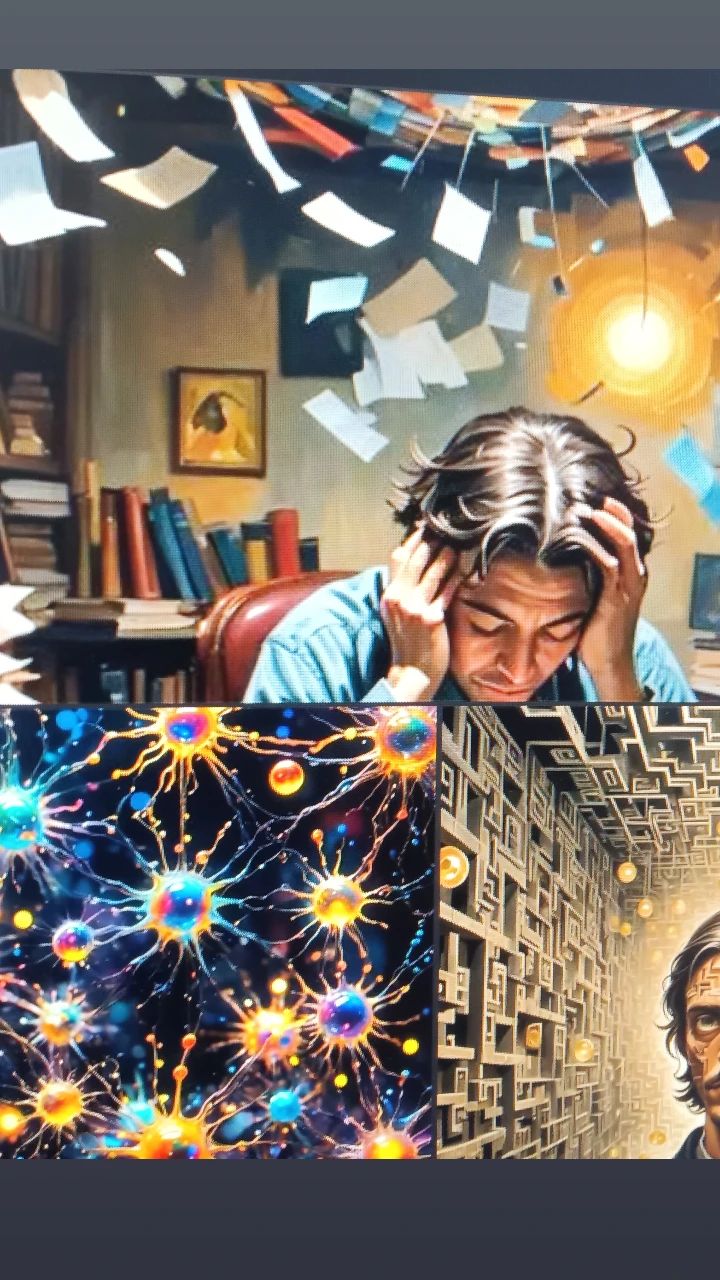
Media theorist Douglas Rushkoff says we’ve lost our sense of narrative in all the fragmentation of attention induced by social media. Indeed, development of multiple identities may be an evolutionary trait in gestation. Considering our minds are magnetic fields attracting what we think to our existence, careful tending of their reciprocal productions is important. To stay in our own movies, we shouldn’t let our attention be managed by these outside currents. There are people, ideas and whole worldviews multiple programmers want us concerned with, the better to sell their products and concepts and services. Because of the nature of society, these are not the self-sustaining or supportive thought-currents, but those perpetuating our dependence on the way things are. Mystic G.I. Gurdjieff said, “Life is only real, then, when ‘I’ am,” noting the infrequency of these moments when we consciously inhabit our lives, taking full account of our position and resources, being otherwise mostly in tow of collective gravities. Gurdjieff also used to say, “Fairness? Decency? How can you expect fairness and decency on a planet of sleeping people?” Inspired by this asleep/awake metaphor, I assumed my first deliberate alter-self, punk poet Henry Alarmclock, which identity I inhabited for about twelve years from age eighteen on. I showed up in Denver as a self-made superhero around 1990 and my self-concept and overall experience changed dramatically. For about ten years, I was really a star in my own backyard. For another ten or fifteen years, I would still get recognized as “Henry” wherever I went. Lots of young people started coming out to read their stuff, taking on their own outrageous pen names—one girl called herself The Great Grapefruit—this other guy Larry changed his name to Peter Yumi (that means archer). At one point I was hosting three or four readings a week, and for a few years my friends and I put on a series of art events called Bleeding TVs of Angels inspired by Situationism—the same French-originated philosophy behind the English end of punk stylistics. The whole scene was revolutionized, or so it seemed to me at the time because of my personal revolution. It’s long been a custom to assume new identities ensuring the success of a chosen adventure, and whether or not that’s correct, the same trope is repeated in most or all superhero origin stories. It’s only a matter of time. That former alter-self of mine and the capabilities it inspired in me remains essential to my self-concept as a vision of self from the past still relevant beyond time. In the same sense, current and future developments in the collective can add to or detract from present and past personal mythology. This kind of unprecedented development is sure to affect our storytelling habits both public and personal. That said, in my opinion, whatever degree of attention we pay to second-or-third-person reportage, it should never assume the role of main character let alone director of our first-person narratives. Your perception of existence is all yours. Looking at behavioral directives as opportunities rather than one-way prescriptions will help.
My Credentials and Practice
I have a Bachelor of Arts degree in Fine Arts and a Master of Fine Arts degree in Writing (fiction) from Vermont College of Fine Arts. I have experience as a ghost writer for multiple clients with wildly divergent life histories and have hosted a number of podcasts and online groups, including “Intuition in Chaos” and “Writing Your Supernatural Journey” at Althea Center for Engaged Spirituality. I recently received my Certification in Narrative Therapy – Fully accredited from Dr. Krishna N. Sharma, PhD at Udemy.com. In my role as host of our paid conversation, I’ll ask for an overview of your circumstances as relates to whatever situation is at issue—a bird’s eye view with all the major characters, goals, and obstacles—and suggest ways to alter the stories you’re telling to and about themselves, increasing production of essential meaning and refreshing your life experiences. As mentioned above, the Narrative Therapy motif emphasizes composition of a letter by the client to a past or future version of self with the aim of contradicting and rewriting the client’s personal narrative. Ideally, we’ll get this done in three consultations of 45 minutes or less, to include composition of the appropriate written catharsis (it may not be a letter that’s called for in every case—it might be a rock opera you need or a comedy skit), after which, additional sessions are available as indicated. Rates are negotiable depending on conditions.